• Blog
  • About
Powered by Blogger.

Path to prosperity

Earlier this morning, Mapletree Industrial Trust (MINT) announced the acquisition of 60% stake in a portfolio of 14 data centres in the United States. Pre-acquisition, MINT held a 40% stake it acquired in 2017 together with its parent, which acquired 60%. Post-acquisition, MINT will own 100% of the portfolio and its exposure to the US will increase to 32.5%; data centres will now make up 39% of its portfolio. 

MINT Portfolio Breakdown (Source: MINT)

The portfolio is an extension of what it already has and improves the stability of MINT's income with a long WALE of 4.6 years, occupancy of 97.4% and less than 20% of leases expiring in the next 3 years. I think this plays very nicely into the whole data infrastructure trend that Covid-19 has accelerated. Importantly for shareholders, the acquisition is DPU accretive by 3.4% on a pro-forma basis. While minority shareholders could have their % stakes diluted somewhat by the placement, I think that this is largely irrelevant as DPU continues to grow and individual shareholders really don't own that much %-wise. 
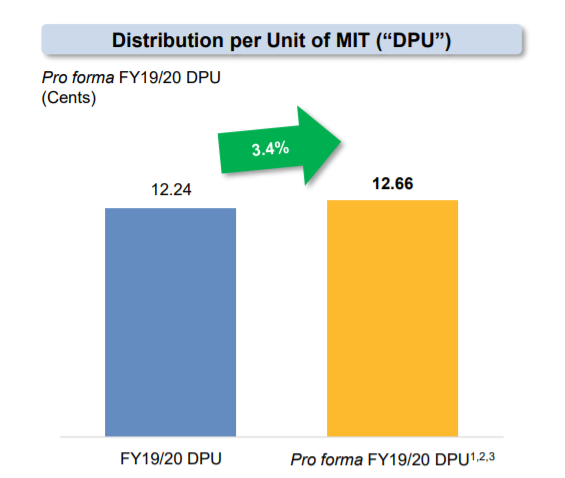
MINT DPU Accretion (Source: MINT)

The S$299m acquisition will be fully funded by a placement exercise which aims to raise at least S$350m with an upsize option for another S$50m. The issue price range of S$2.732 and S$2.800 implies a 5.0-2.6% discount to its VWAP (volume-weighted average price) of S$2.8745. 

It has a forward trading yield of 4.3% which explains why it was able to make a fully equity funded acquisition 3.4% DPU accretive on a pro-forma basis. Typically, large acquisitions would have to be funded via a mix of debt and equity as asset yields would be lower than stock trading yield. But in this case, it appears that MINT's 4.3% FY20F yield is lower than the data centre portfolio's yield. Based on past reports, data centre yields are between 5-7%. 

MINT is raising more than it requires with S$302.6m out of the S$350m going to the acquisition and the remainder being applied to pay off debt or kept for working capital purposes. While the general market is still reeling from the Covid-19 situation, MINT has performed well and is using its strength to raise more capital. Interestingly, even though it fully funded the acquisition by equity and even raised more than it needs, MINT's proforma aggregate leverage is expected to increase from 37.6% to 38.7%. 

MINT use of funds (Source: MINT)

Overall I think this is a good acquisition for MINT and shows that it is making full use of its strong share price to raise capital. It was trading at almost 1.8x P/B before it was halted this morning. This acquisition also reminds the market of the importance of having a strong sponsor that can support the REIT in tough times with a growth pipeline. I believe that MINT would not have been able to make a deal with a 3rd-party in this climate as asset-owners continue to cling on tightly to data centre assets. 

Looking ahead, MINT continues to have a growth pipeline in the form of the 2nd and 3rd data centre portfolios that it acquired in 2019 together with its sponsor. Like the current redwood acquisition, I believe that it is only a matter of time before MINT can acquire those sponsor stakes too. In addition to an acquisition-led growth in data centres, MINT could also continue to redevelop its old flatted factories (~22% of portfolio) into high-spec properties just like what it is doing at Kolam Ayer. 
Share
Tweet
Pin
Share
No comments
I recently read an article in TheEdge talking about how the company with the largest market cap in Singapore is not DBS. Instead, it has been replaced with SEA Ltd which is listed on the New York Stock Exchange. Sea has taken over the mantle of most valuable publicly-traded Singaporean company from DBS which has held it since taking over from Singtel in 2017. 
Share price growth of Sea (Source: Google)

As shown in the figure above, the share price of Sea is currently up 171.1% YTD while DBS is down 19%. According to TheEdge, Sea already overtook DBS in May and the gap between Sea and DBS has widened ever since with Sea being worth $10bn more than DBS based on market cap in mid-June. Interestingly Sea has yet to turn a profit while DBS made $1.2bn in the most recent quarter. 

From an economic standpoint, DBS is a key pillar of the Singaporean economy and facilitates the flow of funds as a financial intermediary. On the flip side, Sea is most known for its e-commerce platform Shopee and its gaming platform Garena. Needless to say, the economy can survive without Sea's services but DBS is likely to be deemed 'too big to fail' from a Singaporean context. Sea's valuation has benefited from a few factors

NYSE vs SGX 
Sea is listed on the NYSE and has an average trading volume of 5.2m shares which translates to around US$560m of Sea shares changing hands daily. For DBS, its average trading volume is 7.6m, translating to S$160m of DBS shares being traded. If we standardize the currencies, this implies that Sea has a trading value of almost 5x that of DBS! 

With a much bigger market in the US, Sea can command a higher valuation than it would have if it had listed on the SGX. I believe this is also one of the reasons why another homegrown tech company, Razer chose to list in Hong Kong rather than in Singapore. The Singapore equity market just isn't vibrant enough to give companies good valuations. 

With the crash in share prices, we are probably going to see more delistings/privatizations to come. Although the negative impact to SGX market vibrancy is offset by the increased interest in the share market as bargains emerge. In my earlier article, 'Stay at home and buy stocks', I thought that with the lockdowns, people didn't have much else to do so trading stocks could be a good distraction. 

Exposure to the broader economy
Banks are deeply embedded in the economy and hence are impacted when the economy goes into a recession. In comparison, Sea has been an indirect beneficiary of Covid19 with more customers shopping online and lockdowns keeping people at home playing games. A key point to note is that Sea continues to turn a loss year after year while DBS has a quarterly profit of ~1bn on average. With conditions being ripe for Sea, the optics wouldn't be good if it still can't turn a profit or at least narrow its losses in the coming quarter. 

Operating leverage
From an operating standpoint, a software/platform company should have a much higher operating leverage compared to a bank since the additional cost of providing the game/platform to an additional user is negligible. After accounting for the fixed costs of hiring staff and setting up infrastructure, any additional revenue tends to flow directly to the bottom online. For a bank, providing an additional loan usually implies going to the money markets to get funds and getting charged a 'cost of funds'. Therefore, I believe that Sea has far more scalable products compared to DBS and hence it is according a higher multiple. This can also be seen in the US where the biggest companies are in tech while the Wall Street banks are lagging. 

Overall, I believe that the outperformance of Sea over DBS may continue until the Covid-19 situation dies off and the economy recovers. In the near term, DBS could see further weakness as government support of the economy comes off and businesses and households start to really feel the pain. Globally, the Fed has already announced that it would continue to keep interest rates low and this is a definite negative for banks' net interest margins. 
Share
Tweet
Pin
Share
No comments
The market turmoil induced by Covid-19 has depressed stock prices to the point where sponsors/shareholders feel that the value of their investments would be better realized in the private markets. Earlier this week, a consortium comprising some of Perennial Real Estate Holdings Limited's substantial shareholders announced a voluntary conditional cash offer to privatize and delist PREH at a price of S$0.95 in cash. 

This article will breakdown the terms of the deal, deal rationale and next steps for existing shareholders and potential traders. 

Terms of the deal
The consortium currently owns 82.43% of PREH and other shareholders will receive S$0.95 in cash for each share owned. Non-consortium shareholders that accept the offer will still be entitled to receive the final dividend of 0.20 cents per share for FY19. 

The offer is conditional on the consortium receiving enough acceptances to give it at least 90% stake in PREH, following which it will exercise its right to compulsorily acquire all the remaining shares and delist PREH. Overall this seems like quite a straightforward deal as it is a straight-up cash offer pending shareholder acceptances. 

Based on the stake (17.57%) that minority shareholders have, this would imply that less than half of these shareholders are required to accept the offer for it to become unconditional; the consortium requires an additional 7.57% stake in order to hit the 90% mark. 

Why the deal is happening?
1. Allows minority shareholders to exit their investment at a premium without incurring brokerage fees. The last time PREH was trading at $0.95 was around Jan2016. Since then it has trended downwards and last closed at $0.69 on Friday. 
PREH share price (Source: PREH)

2. Greater flexibility in management. Privatizing the company can free up resources to focus on PREH's strategic objectives rather than pandering to shareholders and the market's short-term whims and fancies. Additionally, a privatized PREH can save on expenses related to maintaining the listing. 

3. Support future capital raising. The current low share price of PREH makes it difficult for PREH to raise capital from the equity markets without significantly diluting shareholders' interests. From the announcement, it seems like the consortium wants to secure a new long-term capital partner possibly at a better valuation from what the market is according to it now. This push for new investors and partners is also supported by their recent partial divestment of their stake in AXA Tower to link up with Alibaba. 

Analysis of the deal and what shareholders should do
The deal prices PREH at 0.6x to its last declared NAV of S$1.584 per share. I believe that the discount would be even larger if we use a revalued NAV (RNAV) as some of its stake in assets were recently divested (111 Somerset and AXA Tower). The consortium is definitely getting excellent value in their privatization offer at a >40% discount. 

While current minority shareholders are selling low, they might not really have much of a choice given the even bigger discount that the public market is according to PREH. Plus if the consortium gets an extra 7.57%, they would be able to take over the entire company anyway. Current investors should hold on to PREH and accept the offer given by the consortium unless they are in dire need of cash urgently. 

When trading reopens, I expect share price to pop to around $0.94-$0.96 to reflect the uncertainty of deal completion and also the additional dividend not accounted for in the $0.95 offer. 

What's the next deal that could happen?
With market weakness setting in, real estate players continue to be trading at large discounts to NAVs and thus could be prime candidates for privatization (as the PREH deal shows). Off the top of my head, I recall that UIC's free float is around 11-12% and this is really close to the regulatory minimum of 10%. There has long been talk of privatizing UIC by controlling shareholder UOL however such talks were always quashed by the rivalry between UOL and the other substantial shareholder, the Gokongwei family. This rivalry could have softened with the passing of patriarch John Gokongwei in end-2019. I will address this potential in another post so stay tuned!
Share
Tweet
Pin
Share
No comments

Ascott Residence Trust (Ascott) owns 88 hospitality properties across 15 countries globally with a range of offerings like serviced residences, hotels and rental housing. Post-merger with Ascendas Hospitality Trust in 2019, it is currently the largest hospitality trust in Asia Pacific and has a market capitalization of S$3bn and S$7.4bn of assets under management. We think that its share price has been beaten down badly by the Covid-19-induced market turmoil and offers investors good value due to:

Highly geared to domestic travel rebound

As economies gradually reopen, governments are encouraging domestic travel to revive their fallen hospitality sectors as borders remain tightly controlled. Given Singapore’s small size and population, domestic travel has a far smaller role in reviving our hospitality sector, in our opinion. We therefore think that more globally diversified hospitality stocks like Ascott, which has exposure across 15 countries, could be more geared to the recovery in domestic travel.

For example, in Japan, which contributes 12% to Ascott’s FY19 gross profit, the government has announced a campaign to stimulate domestic travel by offering subsidies of up to 20,000 Yen per day through discounts and vouchers for hotels and attractions for residents taking domestic trips.

Ascott Residence Trust income diversity (Source: Ascott)

Strong balance sheet positioning it for growth

Ascott has a strong balance sheet due to its 35.4% gearing which implies a S$2.1bn debt headroom before reaching the 50% regulatory limit. It has ~S$300m cash on hand and will be receiving an additional S$163m cash proceeds from the divestment of Somerset Liang Court in 2H20. This strength could allow it to make opportunistic acquisitions, from either third-parties or its sponsor, without an equity fund raising at a time when property valuations could be taking a hit due to the lower cashflow projections from valuers.

Apart from inorganic growth, Ascott’s strong balance sheet allows it to undertake development and asset enhancement projects without putting too much strain on its financials. Examples include the development of lyf@one-north, and the redevelopment of Somerset Liang Court. 

Somerset Liang Court (Source: Ascott)

EPRA NAREIT Index inclusion

One of the benefits highlighted by Ascott for the merger with Ascendas Hospitality was the potential for inclusion into the EPRA NAREIT Developed Index which could lead to a wider investor base (higher visibility) and higher trading liquidity. Despite the decline in Ascott’s share price, its market cap of $3bn allowed it to qualify for index inclusion in Jun20. We think that the inclusion could be a further boost to Ascott’s share price due to inflows from institutional funds, like what FLT and KDCREIT experienced when they were included in 2019.

Key risks to be aware of

As only 11% of its FY19 gross profit is derived in S$, Ascott is exposed to FX risks if the S$ significantly appreciates against the basket of foreign currencies Ascott has exposure to. Additionally, like most other businesses, Ascott would also be negatively impacted if the downturn from Covid-19 is longer than expected or if a second wave of infections materializes. 

Share
Tweet
Pin
Share
1 comments
Earlier today Sembcorp Marine (SCM) announced a recapitalization of S$2.1bn via a rights issue of 5 SCM rights shares for every SCM share currently outstanding at an issue price of S$0.20 per rights share. The amount raised will be supported by an undertaking by Sembcorp Industries (SCI) and Temasek to subscribe for up to S$1.5bn and S$0.6bn respectively.

What is Temasek's endgame
It would be interesting to see what Temasek is planning for SCM as orders have been declining over the past few years since the industry downturn started in 2014. Last year, Temasek did a partial offer for Keppel at $7.35 during which there was chatter that there might be some sort of reorganization of Temasek's offshore marine portfolio by potentially merging Keppel O&M and Sembcorp Marine. There could also be some reorganization of the various portfolios under Keppel and SCI as both do have some other overlapping areas like renewables and infrastructure. 
 
My guess would be that Temasek consolidates the various industries that Keppel and SCI have such that each can be a national champion in that particular area rather than having overlapping competencies and thus having redundancies from a national standpoint. Interestingly, Keppel also released its 2030 vision a while back and this came before the completion of Temasek's partial offer (expected in 3Q2020). 

With Keppel's partial offer still yet to be completed, my guess is that any further moves by Temasek would come after the completion (expected 2H2020). The current move of recapitalizing SCM and demerging it from SCI helps to simplify the org structure and strengthen SCM's balance sheet. This could make SCM a more palatable target for Keppel to take over once the partial offer is completed. 

As this deal makes Temasek a direct shareholder of SCM, I am also wondering if the eventual intention is to privatize SCM. Post-deal, Temasek would own between 30-58% of SCM. My guess would be that Temasek could eventually own ~50% since I expect there will be a number of minority shareholders that do not wish to subscribe to the rights as the industry is declining or shareholders simply do not have sufficient capital set aside for such a large rights issue. 
Shareholding post-rights issue (Source: SCM)

This deal, like the Keppel and SIA deals, has also made clear that Temasek will not hesitate to step in to support its portfolio companies in times of need and could provide further comfort for shareholders of other Temasek-linked companies that this can happen for them if they are in trouble. Whether this deal is good or not is hard to assess without knowing the future steps that Temasek would take. 

Deal details
For every 1000 SCM shares owned, the SCM shareholder will need to cough up $1,000 to subscribe to the 5000 rights shares. To maintain their shareholding percentage, SCM shareholders would have to put up more cash than the value of their SCM shares. As of last closing price, 1000 SCM shares would be worth $850 and shareholders would have to come up with $1000. The figure below also shows that this deal is massively dilutive, although in this case, it appears good because SCM was in a net loss position so the loss per share was reduced. 

The use of proceeds will be split into the same S$1.5bn and S$0.6bn:
S$1.5bn - To repay outstanding principal on the credit facility of S$1.5bn provided by SCI to SCM
S$0.6bn - For working capital and general corporate purposes

Subsequent to the rights issue, there would then be a distribution of SCM shares by SCI to SCI's shareholders. SCI shareholders would receive between 427 and 491 SCM shares for every 100 SCI shares they own. 

Why this is being done
To enhance SCM's balance sheet by deleveraging and lowering interest expense while also doubling its Net Tangible Assets from S$1.9bn to S$4.0bn. This would allow SCM sufficient capital to compete for more projects. 

Pro-forma financial impact of recapitalization (Source: SCM)

What shareholders need to do
SCM shareholders need to decide on whether to approve the rights issue and whitewash resolution separately. For the rights issue, it appears that it is a given granted SCI has >50% and will be voting in favour. Minority shareholders will have more say in the whitewash resolution for the proposed distribution. If the resolutions are approved, SCM shareholders need to decide if they want to sell the rights as they are renounceable or subscribe to the rights for $0.20 per rights share. For every 1000 SCM shares owned, the SCM shareholder will need to cough up $1,000 to subscribe to the 5000 rights shares. 

For SCI shareholders, they need to approve the proposed distribution of SCM shares to them. If the resolutions are all approved, SCI shareholders will receive X amount of SCM shares depending on the subscription rate by SCM shareholders. 
In effect, since the 3 resolutions are inter-conditional, minority shareholders still have the ability to block this deal. 
Shareholder Resolutions (Source: SCM)

Share
Tweet
Pin
Share
No comments
FTSE Russell released the changes to the STI Index following its quarterly review earlier today. Similar to the predictions of the MSCI Index changes, we were spot on again with Mapletree Industrial Trust being added and SPH being deleted. In addition to the index rebalancing, the new reserve list, by market cap, is as follows, FLCT replaces MNACT:

STI Index Inclusions & Exclusions (Source: FTSE Russell)

As explained in the first post about the STI Index rebalancing, the criteria and method of calculation for the index is publicly available from the index provider (FTSE Russell) so it is not difficult for any layman to do such calculations beforehand; it just takes some time to do so. 

After this announcement, investors should take note that the changes will be applied at the close of business on 19 Jun and will be effective on 22 Jun. While the STI Index is less traded compared to the MSCI Singapore, we still think that the fund flows as a result of the rebalancing could have an impact on share prices. MINT could go up due to fund inflows on 22 Jun while SPH should see outflows then. Interestingly, SPH was part of the group that created the STI index. 

For MINT, its share price has bounced back to what it was at the start of 2020. With such a high premium to book value (1.7x P/B), it could continue to make larger acquisitions funded by equity.

Looking ahead, we are cognizant that CCT will be deleted from the index after its merger with CMT, upon which KDCREIT could take its place as the stock in the reserve list with the highest market cap. However, with Covid-19, the merger could face delays so this rebalancing may not happen so soon. 


Share
Tweet
Pin
Share
No comments
This post is a follow up from my earlier post about the MSCI Singapore rebalancing (MSCI Singapore Index Rebalancing Impact on Stocks)

Quick recap: MSCI announced a rebalancing of the MSCI Singapore and MSCI Singapore Small-Cap indices resulting in the trading idea of buying the additions and shorting the deletions. In particular, I highlighted that the impact from the MSCI Singapore changes would be much larger than the Small-Cap index due to the size of funds tracking them. 

MSCI Singapore Small-Cap Changes (Source: MSCI)

MSCI Singapore Changes (Source: MSCI)

The price changes in the abovementioned stocks appear to be reflective of the initial thesis I had. This price was supported by extremely strong volume across the few stocks, way above their daily average trading volumes. Post-cutoff date, as funds finish up with their buying, there is a chance that investors who have benefitted from the price increases would take the chance to realize some profit for stocks that have been added (ie. MLT) and pick up the deletions (ie. SATS) if the sell down is too great. 
Top Value Traded for 29 May 2020 (Source: SGX)


Changes in price from announcement to cut-off date

Moving forward, the dates for the next MSCI quarterly reviews have been announced. Given the continuing volatility in markets, prices will continue to fluctuate wildly and we can expect the weightings of MSCI constituents to change. Additionally, businesses that are deemed less future proof could see more outflows leading to them being dropped from the index or vice versa. A well-known example is that of Zoom, which has jumped 150% since 2nd Jan 2020 and has been added into the NASDAQ and the MSCI America. 
MSCI Review Dates (Source: MSCI)

Share
Tweet
Pin
Share
No comments
Newer Posts
Older Posts

Popular Posts

  • MSCI Singapore Index rebalancing impact on stocks
  • Office REITs results round up: WFH a boon or bane?
  • 3 key concerns REIT investors should take note of

Tags

  • Centurion Corp
  • Consumer
  • Covid-19
  • Coworking
  • Eagle Hospitality Trust
  • Gloves
  • Healthcare
  • Index
  • Property
  • REITs
  • Sembcorp
  • SPH REIT
  • Supermarket

Blog Archive

  • ▼  2021 (3)
    • ▼  6 Jun - 13 Jun (1)
      • ARA Logos Logistics Trust: 3 reasons to drive a re...
    • ►  21 Feb - 28 Feb (1)
    • ►  24 Jan - 31 Jan (1)
  • ►  2020 (43)
    • ►  30 Aug - 6 Sep (1)
    • ►  23 Aug - 30 Aug (1)
    • ►  9 Aug - 16 Aug (1)
    • ►  2 Aug - 9 Aug (2)
    • ►  26 Jul - 2 Aug (2)
    • ►  19 Jul - 26 Jul (2)
    • ►  12 Jul - 19 Jul (2)
    • ►  28 Jun - 5 Jul (2)
    • ►  21 Jun - 28 Jun (2)
    • ►  14 Jun - 21 Jun (2)
    • ►  7 Jun - 14 Jun (2)
    • ►  31 May - 7 Jun (1)
    • ►  24 May - 31 May (3)
    • ►  17 May - 24 May (1)
    • ►  10 May - 17 May (3)
    • ►  3 May - 10 May (2)
    • ►  26 Apr - 3 May (3)
    • ►  19 Apr - 26 Apr (1)
    • ►  12 Apr - 19 Apr (2)
    • ►  5 Apr - 12 Apr (2)
    • ►  29 Mar - 5 Apr (2)
    • ►  22 Mar - 29 Mar (2)
    • ►  15 Mar - 22 Mar (2)

Created with by ThemeXpose